Split AC Installation in Dubai
Split AC installation covers sizing, siting and fitting a new air conditioning system — indoor unit, outdoor condenser, refrigerant pipework, drainage and electrical supply. In Dubai, the two things that determine whether you are happy with the result five years later are correct BTU sizing and proper installation quality. SWEFIX handles both, plus building and DEWA approvals where required.
Getting the Size Right
An undersized unit runs constantly, never reaches temperature in July, and burns out early. An oversized unit short-cycles, fails to remove humidity, and leaves the room cold but clammy. Both waste money.
As a rough starting point for Dubai conditions:
Room size | Typical capacity | Notes |
|---|---|---|
Up to 12 m² — small bedroom, study | 9,000 BTU (0.75 ton) | Add capacity if west-facing |
12–18 m² — standard bedroom | 12,000 BTU (1 ton) | The most common apartment size |
18–25 m² — master bedroom, small living room | 18,000 BTU (1.5 ton) | |
25–35 m² — living room, open-plan | 24,000 BTU (2 ton) | Consider two units for even distribution |
35–45 m² — large living area | 30,000–36,000 BTU (2.5–3 ton) | Usually better served by two units or ducted |
These are starting points, not a specification. Actual sizing depends on ceiling height, glazing area and orientation, insulation, floor level, how many people use the room, and whether the space contains heat-generating equipment. We calculate it properly on site rather than guessing from floor area.
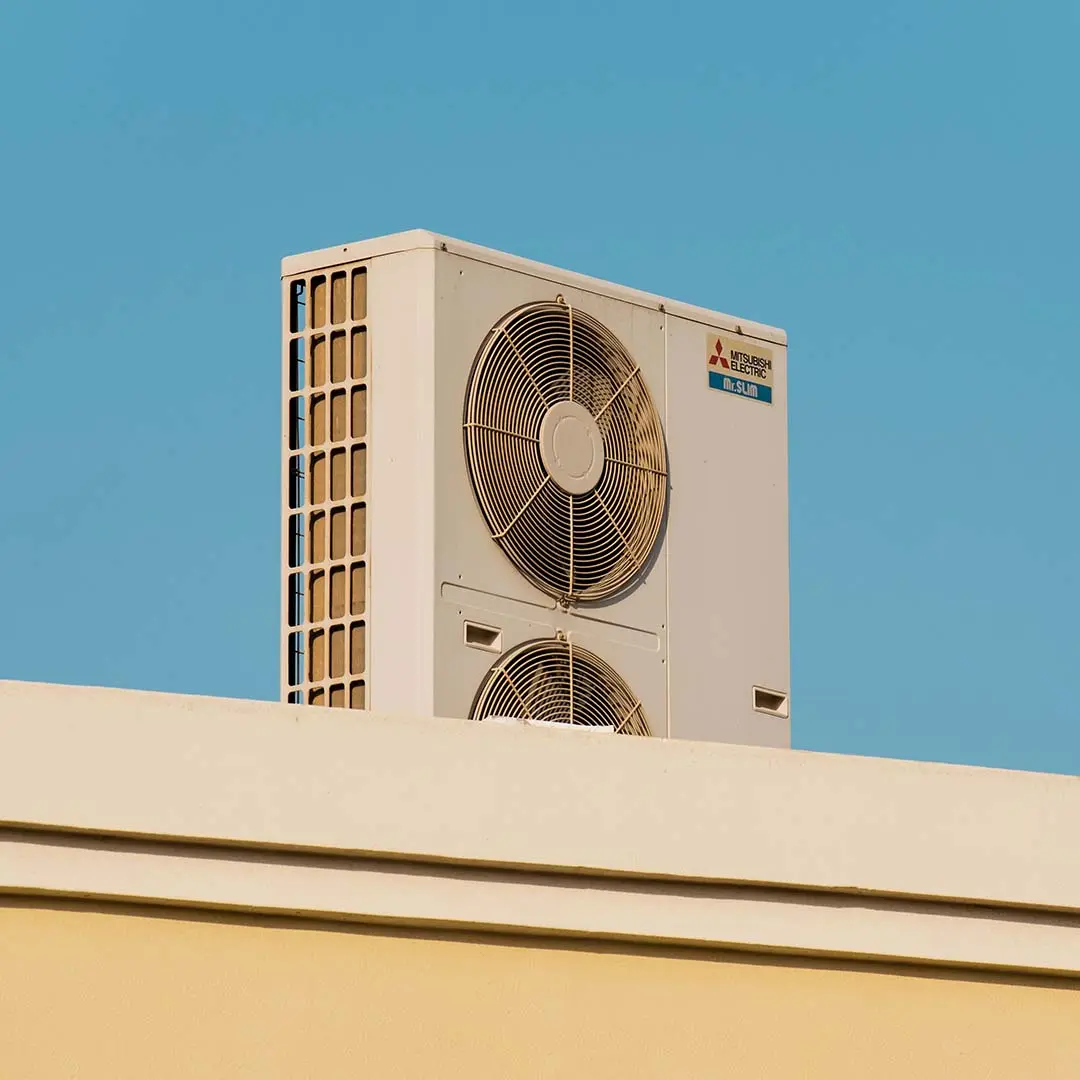
Unit Types We Install
- Wall-mounted split — the standard choice for apartments and bedrooms. Efficient, straightforward to service, widest model range.
- Cassette — ceiling-recessed with four-way airflow. Better distribution in square rooms and offices; needs ceiling void.
- Floor-standing — for spaces where wall mounting is not practical, or where high capacity is needed in one location.
- Ducted split — concealed unit feeding multiple rooms through ducting. Cleanest visual result; needs ceiling space and planning.
- Multi-split — several indoor units on one outdoor condenser. Useful where outdoor space is limited, common in apartments.
Inverter or Fixed Speed?
For anything that runs regularly in Dubai, choose inverter. A fixed-speed compressor switches fully on and fully off; an inverter varies its speed to match demand, which cuts consumption meaningfully, holds temperature more steadily, and runs considerably quieter. The higher purchase price is recovered through the DEWA bill, and in a climate where the unit runs nine months a year that payback is faster here than almost anywhere.
Our Installation Process
- Site survey. We measure the space, assess orientation and glazing, check the electrical supply, and identify where the outdoor unit can go.
- Sizing and quotation. You receive a capacity recommendation and a fixed price covering supply, installation, materials and approvals.
- Approvals. Most Dubai buildings require an NOC for AC installation, and some require DEWA notification. We handle the paperwork.
- Installation. Mounting, refrigerant pipework with proper flaring and insulation, condensate drainage with correct fall, and electrical connection.
- Vacuum and charge. The circuit is evacuated with a vacuum pump before charging — the step careless installers skip, and the reason many new systems fail within two years.
- Commissioning and testing. Pressure test, airflow and temperature differential check, thermostat configuration, and a full run test.
- Handover. We demonstrate the controls, explain filter cleaning, register the manufacturer warranty, and clean up.
What Separates a Good Installation From a Bad One
Most premature AC failures in Dubai trace back to installation rather than the equipment. The things that matter:
- Proper vacuum before charging. Moisture and air left in the circuit corrode components from the inside and shorten compressor life dramatically.
- Correct drainage fall. Get this wrong and you have water coming through your ceiling within a year.
- Fully insulated refrigerant pipework. Uninsulated runs sweat, drip and waste cooling capacity.
- Outdoor unit siting with adequate clearance and, where possible, out of direct afternoon sun.
- Correctly rated and protected electrical supply, with its own isolator.
- Indoor unit positioning that actually distributes air across the room rather than straight at the nearest wall.
Replacing an Existing Unit
If you are replacing rather than installing new, we assess whether the existing pipework, drainage and electrical supply can be reused — which reduces cost and disruption — or whether they need renewing. Older installations using R22 refrigerant always need the pipework flushed or replaced before a modern unit is connected. We remove and dispose of the old equipment responsibly.
Frequently Asked Questions
Installation cost depends on unit capacity, the pipe run length between indoor and outdoor units, whether the electrical supply needs work, and access. We quote a fixed price after the site survey, covering supply, fitting, materials and approvals with no additions afterwards.
Either. We supply and install, which usually works out better because we handle the warranty as a single point of responsibility. If you have already bought a unit, we are happy to install it.
A single wall-mounted split unit is typically half a day. Multiple units or a multi-split system take one to two days. Ducted installations take longer and are quoted individually after survey.
Most buildings and communities require an NOC from the owners association or developer before AC installation, particularly where the outdoor unit affects the facade. Some situations also require DEWA notification. We handle the approvals as part of the job.
As a starting point, roughly 12,000 BTU for a standard bedroom of 12–18 m² and 24,000 BTU for a 25–35 m² living room. Orientation, glazing, ceiling height and occupancy all change that, so we calculate it properly on site rather than working from floor area alone.
For any unit in regular use, yes. Inverter systems consume noticeably less power, hold temperature more consistently and run quieter. Given that AC runs nine months of the year in Dubai, the saving on your DEWA bill recovers the price difference relatively quickly.
Yes. Installation workmanship carries a 90-day warranty, and the unit itself carries its manufacturer warranty, which we register on your behalf. We also recommend an HVAC maintenance contract from year one — most manufacturer warranties require evidence of servicing.
Book a Site Survey
Book a Site Survey
Contact us
